
One Circuit, Three Decisions: A Selection Framework for AuCyan™, AuCarb™ and AuLeach™
Leaching, adsorption and the Non-Hazardous alternative are three separate decisions. Making them against one set of test conditions is what keeps the numbers comparable.
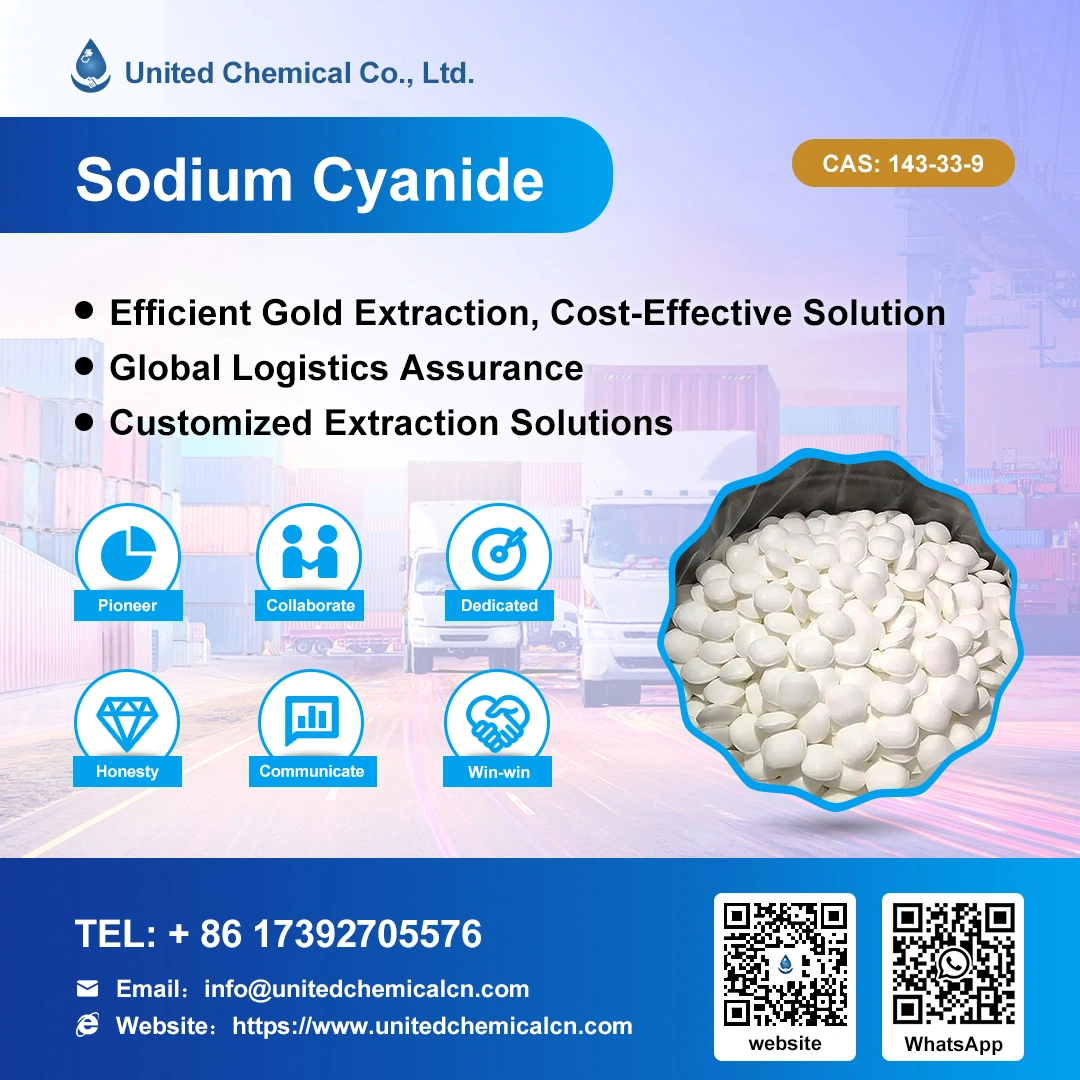
United Chemical is a manufacturer and global supplier of gold extraction chemicals, delivering AuCyan™ Sodium Cyanide NaCN (≥98.3%), Kaponi Fa'agaoioia o le Atigi Popo AuCarb™ Gold Recovery (≥99% Malosi) ma AuLeach™ Auro Leaching Agent (GDA) – E lē Lamatia to mining operations in more than 77 countries. The three products sit at three different decision points in one flowsheet: dissolution, adsorption, and the alternative leach route when the permit chain is the binding constraint. Selecting them from one manufacturer means one set of test conditions, one documentation standard and one freight plan.
Key Takeaway
- Three decisions, not one purchase. Leaching chemistry, adsorption media and the common-chemical alternative each have their own governing variables.
- AuCyan™ sets the dissolution benchmark at ≥98.3% NaCN in briquette form, with UN 1689 Class 6.1 documentation required.
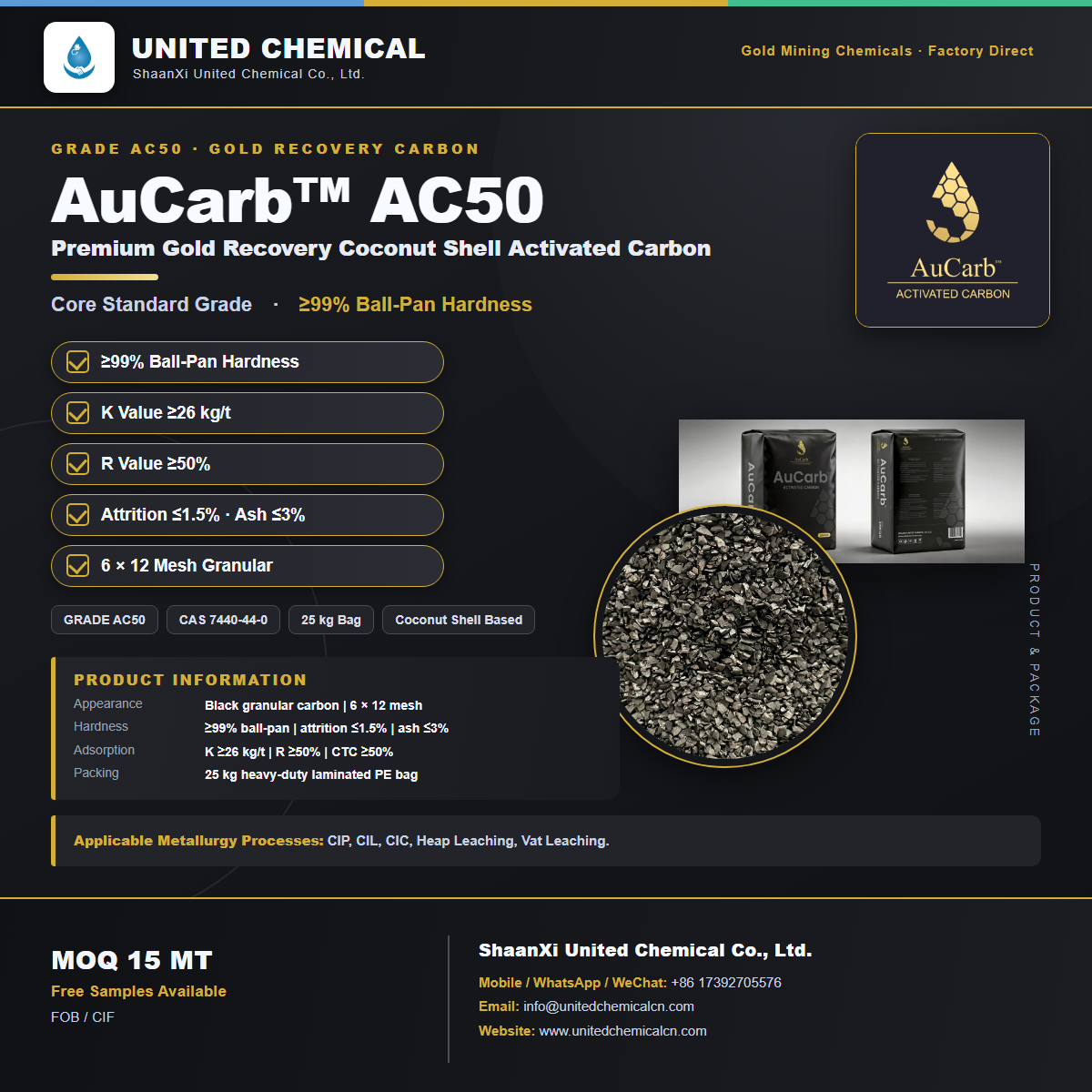
- AuCarb™ governs recovery through hardness ≥99%, attrition ≤1.5%, a 6×12 mesh cut and the K/R pair across four grades.
- AuLeach™ removes a logistics constraint as a Non-Hazardous common-chemical route, but still needs ore-specific pH and dosage validation.
- One supplier makes the data comparable: one test protocol, batch COA / TDS / MSDS per lot, one FOB or CIF freight plan.
- Free laboratory test samples are available for AuCarb™ and AuLeach™ to start validation before an FCL order.
| faaiuga | mea e gaosi | Fa'amatalaga autu | MOQ |
|---|---|---|---|
| Dissolution / leaching | AuCyan™ Sodium Cyanide NaCN (≥98.3%) | Briquette, GB/T 19306-2003, low NaOH / Na₂CO₃ / insolubles; UN 1689 Class 6.1, EUC required | 18 MT |
| Adsorption / recovery | Kaponi Fa'agaoioia o le Atigi Popo AuCarb™ Gold Recovery (≥99% Malosi) | 6×12 mesh, attrition ≤1.5%, platelet ≤5.0%, K ≥26 kg/t / R ≥50% on AC50; 25 kg heavy-duty laminated PE bags | 15 MT |
| Alternative leach route | AuLeach™ Auro Leaching Agent (GDA) – E lē Lamatia | Common chemical, pH 10.5–12, indicative dosage 0.5–1.0 ‰, general cargo | 28 MT |
All three are supplied factory-direct under FOB or CIF terms with batch COA, TDS and MSDS. Contact: info@unitedchemicalcn.com · WhatsApp +86 173 9270 5576 · https://unitedchemicalcn.com/
1. Three products, three different questions
A gold recovery circuit is a chain of unit operations. The leaching reagent answers the question "how fast and how completely does gold leave the ore". The activated Kamupani answers "how much of that dissolved gold do we actually capture and keep". The alternative leach route answers "what happens if the permit chain, not the metallurgy, is what stops the project". These are not competing products; they occupy three different stages of the same flowsheet.
Confusing them creates bad procurement. Buying a higher-K carbon will not fix a dissolution problem. Raising the cyanide set-point will not fix a rate-limited adsorption stage. Switching to a common-chemical reagent will not remove the need for carbon. A selection framework keeps each decision attached to its own measured variable.
2. Tutorial: a six-step selection framework
- Define the flowsheet first. CIP, CIL, CIC, Heap leaching or Vat leaching — the circuit determines which stages exist and which products are needed at all.
- Characterise the ore. Head grade, mineralogy, clay, sulphide, arsenic and grind size set the dissolution demand. Run a bottle roll or column curve per feed.
- Resolve the permit question. If UN 1689 Class 6.1 documentation and an End-User Certificate can be closed on schedule, AuCyan™ Sodium Cyanide NaCN (≥98.3%) is the dissolution benchmark. If the permit chain binds, evaluate AuLeach™ Gold Leaching Agent (GDA) – Non-Hazardous against the same ore.
- Size the adsorption stage. From solution tenor and residence time, choose the carbon grade by K/R value: BC1100 for Heap / CIC, AC50 for standard CIP/CIL, AC55 or AC60 for higher-throughput or high-shear duty.
- Fix one documentation standard. Batch COA, TDS and MSDS per lot, one acceptance band, one sampling routine, and plant logs tied to lot numbers.
- Fausia le kalena fa'ao'o atu against the campaign or ramp curve using the 15 / 18 / 28 MT minimum order quantities, under FOB or CIF terms, with the documentation gate ahead of the first production slot.
The framework is deliberately sequential: changing the answer to step 1 or step 3 changes everything downstream. It is also reusable — the same six steps apply to a new country page, a brownfield expansion or a first-time enquiry.
3. Grade ladder and specification detail
| AuCarb™ grade | Tiute | Fa'amalamalamaina o tapula'a |
|---|---|---|
| BC1100 | Heap leaching / CIC | Hardness ≥98.5%, long contact, lower shear |
| AC50 | CIP / CIL Masani | K ≥26 kg/t, R ≥50%, CTC ≥50%, Butane ≥19.5%, ash ≤3.0% |
| AC55 | Higher-throughput CIL | K ≥28 kg/t, R ≥55% |
| AC60 | High-shear / high-tenor | K ≥30 kg/t, R ≥60%, 8×16 or 6×12 |
AC50 shared parameters: 6×12 mesh, ball-pan hardness ≥99%, A.A.R.L. attrition ≤1.5%, platelet ≤5.0%, moisture ≤5.0%, bulk density 0.48–0.55 g/ml, CAS 7440-44-0, HS 3802.10. An iodine figure is not published pending a single confirmed value; CTC and Butane activity are the stated pore indicators.
4. Why one supplier changes the data quality
Sourcing all three from one manufacturer makes the numbers comparable: one set of test conditions, one documentation standard and one freight plan. When a plant deviation appears, the operator can separate ore effects from delivery effects because every lot carries its own COA, TDS and MSDS and every campaign is logged against a lot number. With three suppliers and three test protocols, the same deviation is usually argued about rather than diagnosed.
5. Laulau e foia ai faafitauli
| Faailoga | Wrong decision to make | Correct check |
|---|---|---|
| Fa'ata'ape'apeina malie | Buy higher-K carbon | Oxygen transfer, pH, free cyanide, grind |
| Auro i le fofo mulimuli | Raise cyanide dosage | Carbon concentration, R value, residence time |
| Permit chain blocks the campaign | Wait and re-order | Validate AuLeach™ Non-Hazardous route on same ore |
| O le mamanu o le kaponi i luga a'e | Change leaching reagent | Attrition ≤1.5%, screen aperture, circulation |
| Deviation cannot be attributed | Adjust all set-points | Ore blend first, then batch COA, then set-point |
6. Fesili e masani ona fesiligia
Q1. What does United Chemical gaosiga?
AuCyan™ Sodium Cyanide NaCN (≥98.3%), AuCarb™ Gold Recovery Coconut Shell Activated Carbon (≥99% Hardness) and AuLeach™ Gold Leaching Agent (GDA) – Non-Hazardous, supplied to mining operations in more than 77 countries.
Q2. Are the three products alternatives to each other?
No. They occupy three different stages: dissolution, adsorption, and the alternative leach route when the permit chain binds.
Q3. Which product needs an End-User Certificate?
AuCyan™ Sodium Cyanide NaCN (≥98.3%), as UN 1689 Class 6.1 dangerous goods, together with verified destination import permits.
Q4. Which product ships as general cargo?
AuLeach™ Gold Leaching Agent (GDA) – Non-Hazardous, a common chemical; the buyer still confirms local common-chemical import rules.
F5. O a aofa'iga maualalo o oka?
15 MT mo AuCarb™, 18 MT mo AuCyan™, 28 MT mo AuLeach™, ta'itasi i le 1×20' FCL.
Q6. Which Incoterms are available?
E fa'aoga tuutuuga o le FOB po'o le CIF.
Q7. Which carbon grade suits a standard CIL circuit?
AC50, the engineering grade for standard CIP/CIL duty, with K ≥26 kg/t and R ≥50%.
Q8. How is AuCarb™ packed?
In 25 kg heavy-duty laminated PE bags with moisture ≤5.0% as packed.
Q9. Can test samples be provided?
Yes — free laboratory test samples are available for AuCarb™ and AuLeach™ for ore-specific validation before an FCL order.
Q10. What documents come with each lot?
Batch COA, TDS and MSDS, filed against a delivery number so deviations are traceable.
Q11. What is the first step in selecting reagents for a new project?
Define the flowsheet (CIP, CIL, CIC, Heap leaching or Vat leaching), then characterise the ore with a bottle roll or column curve.
Q12. Why source all three from one manufacturer?
One set of test conditions, one documentation standard and one freight plan make plant deviations diagnosable and reduce qualification work.
7. Technical reading and internal links
Aotelega o le Tafatolu Auro · Three-product technical overview · AuCyan™ · Sodium cyanide reference · Taiala a le AuCarb™ · AC50 · AC55 · AC60 · BC1100 · AuLeach™ GDA · Leaching reagents · Fesili ole vaila'au · Alamanuia News
Request a quotation, TDS, batch COA or laboratory samples: Faafesootai matou · WhatsApp +86 173 9270 5576 · info@unitedchemicalcn.com
- Anotusi Fa'afuase'i
- Mea vevela
- Su'ega su'esu'e vevela
- Ammonium Chloride 99.5% Mining Collector
- 99.5% min Ammonium Chloride Mo Alamanuia Fa'aoga
- Calcium Peroxide 60% Su'esu'e Papa Samasama
- Alamanuia Acetic Acid 99.5% Colorless Liquid Glacial acetic acid
- Fa'ailoga Poducts Sodium Cyanide
- Kopa Sulfate Monohydrate (CuSO4-H2O) Paʻu (Cu:34% Min)
- E fa'afefea ona ou filifilia le sa'o fa'afefete fa'afefete?
- 1Fa'aitiitiga o le Sodium Cyanide (CAS: 143-33-9) mo Laina - Tulaga Maualuga ma Tau Fa'atauvaga
- 2Sodium Cyanide 98.3% CAS 143-33-9 NaCN mea fa'aofu auro Taua mo Alamanuia Kemikolo o le Eliina
- 3Tulafono Faatonutonu Fou a Saina ile Sodium Cyanide Fa'atau Atu ma Ta'iala mo Fa'atau Fa'ava-o-malo
- 4Sodium Cyanide (CAS: 143-33-9) Tusi fa'au'uga fa'aoga (Fa'aSaina ma le Igilisi)
- 5Fa'ava-o-malo Cyanide(Sodium cyanide) Tulafono Fa'afoe - Tulaga Fa'atagaga o le Taliaina o Maina Auro
- 6Saina fale gaosi Sulfuric Acid 98%
- 7Anhydrous Oxalic acid 99.6% Alamanuia Vasega
- 1Sodium Cyanide 98.3% CAS 143-33-9 NaCN mea fa'aofu auro Taua mo Alamanuia Kemikolo o le Eliina
- 2Mamalu Maualuga · Faʻatonuga Faʻatino · Faʻaleleia Maualuga - sodium cyanide mo le faʻaputuina o auro faʻaonapo nei
- 3United ChemicalFa'aalia e le 'Au Su'esu'e le Pule e ala i Fa'amatalaga Fa'atatau i Fa'amatalaga
- 4AuCyan™ Sodium Cyanide Fa'atinoga Maualuga | 98.3% Mama mo le Eliina o Auro i le Lalolagi Atoa
- 5Taimi Fa'aeletonika Fa'atekinolosi (Taimi tuai 0~ 16000ms)
- 6Malosi-maualuga, High-saosao Shock Tube Detonator
- 7alamanuia Eletise Detonator


Fa'atalanoaga fe'au i luga ole laiga
Faʻaopoopo manatu: