

UNITED CHEMICAL · ÌMỌ̀-Ẹ̀RỌ̀ ỌJÀ · 27 Oṣù Kọkànlá 2026
awọn erogba you replace is not the carbon you lose
Fines carry gold out of the circuit, and they rarely appear on the purchase order.
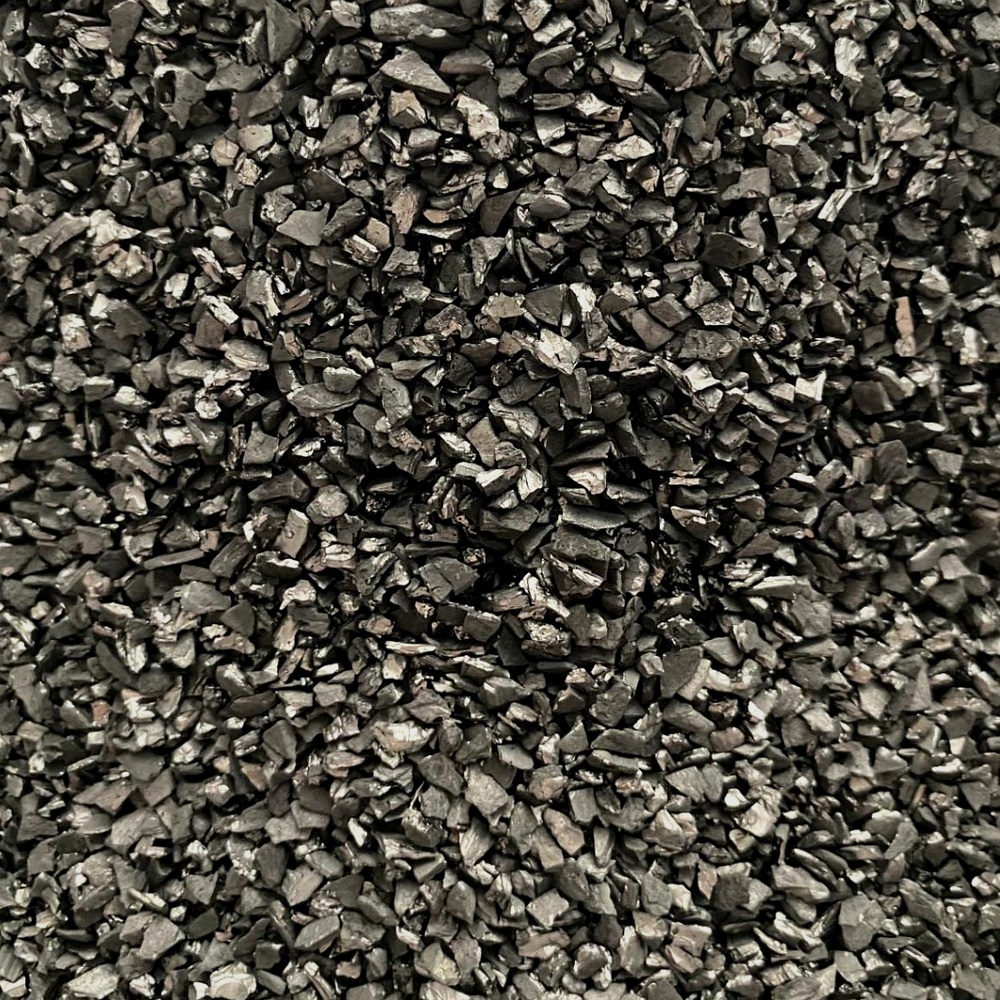
Activated carbon is consumed two ways. It leaves as loaded carbon after elution, and it grinds into fines that report to tailings carrying adsorbed gold. The second loss is rarely budgeted. Ball-pan hardness and AARL attrition predict it; mesh size and platelet count predict how fast it happens in a given circuit. This guide uses AuCarb™ Gold Recovery Shell Coconut Shell Activated Carbon (≥99% Lile) as the worked example.
1. Three steps from solution to loaded carbon
Film diffusion — the [Au(CN)₂]⁻ complex crosses the solution boundary layer around each granule. Agitation controls this step.
Pore diffusion — the complex travels into internal pores. Granule size and pore structure control this step.
Surface adsorption — the complex binds to active sites. Surface chemistry and total area control this step.
2. Why hardness is a recovery parameter
A granule that breaks in a stirred tank shortens diffusion paths but creates gold-bearing fines that escape the adsorption circuit. In an abrasive ore, moving from a marginal product to one at ball-pan hardness ≥99% with AARL attrition ≤1.5% cuts fines generation directly. The AC50 verified data set is: 6×12 mesh, ball-pan ≥99%, AARL attrition ≤1.5%, platelet ≤5.0%, K ≥26 kg/t, R ≥50%, CTC ≥50%, butane ≥19.5%, ash ≤3.0%, moisture ≤5.0%, bulk density 0.48–0.55 g/mL. Iodine value is deliberately omitted — published figures conflict, so CTC and butane activity are the auditable measures.
Triangle Golden — awọn ọja mẹta, olupese kan
AuCyan™ Sodium Cyanide NaCN (≥98.3%) · AuCarb™ Gold Recovery Shell Coconut Shell Activated Carbon (≥99% Lileness) · Agent AuLeach™ Gold Leaching (GDA) – Kì í ṣe Ewu
3. Worked calculation: the cost of fines
A 2,000 t/day CIL plant carries 12 tonnes of carbon with a 30-day cycle. At 1.5% attrition per cycle it loses about 180 kg per cycle, or 2.2 tonnes a year. At 3.0% it loses roughly 4.3 tonnes — a difference of 2.1 tonnes of carbon. If those fines carry even 200 g/t of gold, the annual gold difference is about 420 g. At any reasonable gold price, the hardness premium paid for the better carbon is smaller than the gold saved.
1.5% attrition: ≈ 2.2 t/year make-up carbon
3.0% attrition: ≈ 4.3 t/year make-up carbon
4. K and R are not the same number
K value is the adsorption rate constant — how fast gold loads. R value is equilibrium capacity — how much it holds. A high K with modest R suits short contact time. A high R suits a circuit that runs carbon to heavy loading before elution. Buying on either alone is a common and expensive mistake. Run bottle-roll loading on your own ore, set the K/R target from your contact time, then buy the lowest grade that reaches it.
5. Awọn ipele mẹrin, awọn iṣẹ mẹrin
| ite | Circuit | Ṣíṣàlàyé pàtó |
|---|---|---|
| BC1100 | Ìyọkúrò òkìtì / Erogba-nínú-ọ̀wọ̀n | Iṣẹ ṣiṣe giga fun awọn solusan ipele kekere |
| AC50 | Standard CIP/CIL | 6×12 mesh, K ≥26, R ≥50%, CTC ≥50% |
| AC55 | CIP/CIL tí ó ga jùlọ | K ≥28 kg/t, R ≥55% |
| AC60 | CIP/CIL Ere-giga | K ≥30 kg/t, R ≥60%, 8×16 tàbí 6×12 |
6. Àtúnṣe àti ìgbésí ayé ìyípo
Loaded carbon is eluted and thermally regenerated before returning to the circuit. Every cycle imposes thermal and mechanical stress. Platelets and weak granules are preferentially lost in handling and regeneration. A carbon at ball-pan hardness ≥99% with platelet ≤5.0% typically sustains more cycles before make-up is required. Packing is Àwọn àpò PE tí a fi ṣe àwọ̀ 25 kg, with a batch pẹlu awọn, TDS ati MSDSMOQ ni 1×20' FCL ≈ 15 MT labẹ FOB / CIF terms; United Chemical ń ṣiṣẹ́ fún àwọn orílẹ̀-èdè tó ju 77 lọ.
5b. Screening and fines recovery
Attrition control does not end at the carbon specification. Screen condition determines whether a broken granule is removed cleanly or ground further and carried forward. A worn screen with oversized apertures passes loaded fines into the tailings stream; a blinded screen holds carbon in the tank too long and increases grinding. The practical routine is to log screen aperture, inspect panels on a fixed schedule and sample the carbon size distribution in the circuit monthly. If the proportion of sub-millimetre material is rising while make-up carbon is on budget, the problem is mechanical rather than metallurgical. Equally, gold-bearing fines caught on a screen are not lost; they should be routed to the elution circuit where the recovery economics justify it. This is why hardness and attrition numbers belong in an operating dashboard, not only in the purchase order.
7. Ibeere
Q1 — Kí ni ≥99% líle túmọ̀ sí ní ìṣe?
Ball-pan hardness ≥99% means the granule resists mechanical breakdown to a defined standard, reducing fines.
Q2 — Which mesh size?
6×12 for agitated CIP/CIL, 8×16 where finer loading is needed, BC1100 for columns and heap.
Ìbéèrè 3 — Ṣé o ń gbé iye iodine jáde?
No — CTC and butane activity are the auditable pore measures because published iodine figures conflict.
Q4 — Kí ni a fi ránṣẹ́ pẹ̀lú gbogbo ìpele?
Batch COA, TDS àti MSDS nínú àwọn àpò PE tí wọ́n fi 25 kg ṣe tí wọ́n sì ní àwọ̀ tó lágbára.
Q5 — Kí ni MOQ?
1×20' FCL ≈ 15 MT, FOB tàbí CIF.
Q6 — Can I test before buying?
Bẹ́ẹ̀ni — àwọn àpẹẹrẹ ọ̀fẹ́ ti AuCarb™ àti AuLeach™ fún ìdánwò yàrá ìdánwò ara ẹni.
Measure your attrition loss
Tell us your circuit type, screen aperture and ore abrasiveness. We propose a grade, a K/R target and a test protocol.
Pe wa · AC50 · AC55 · AC60 · Àkójọpọ̀ Golden Triangle
WhatsApp +86 173 9270 5576 · info@unitedchemicalcn.com
- Akoonu ID
- Gbona akoonu
- Hot awotẹlẹ akoonu
- Ile-iṣẹ China Sulfuric Acid 98%
- Sulfuric Acid 98% Ite Iṣẹ
- Ṣiṣu Shock Tube (VOD≧1600m/s)
- Irin Sulfate Ipele Ile-iṣẹ 90%
- Ṣe awọn reagents flotation ni awọn ipa ayika?
- 1Sodium Cyanide ẹdinwo (CAS: 143-33-9) fun iwakusa - Didara to gaju & Ifowoleri Idije
- 2Sodium Cyanide 98.3% CAS 143-33-9 Ohun elo asọ goolu NaCN Pataki fun Iwakusa Awọn ile-iṣẹ Kemikali
- 3Awọn Ilana Tuntun ti Ilu China lori Awọn agbejade Sodium Cyanide ati Itọsọna fun Awọn olura Kariaye
- 4Sodium Cyanide (CAS: 143-33-9) Ijẹrisi olumulo ipari (Ẹya Kannada ati Gẹẹsi)
- 5Cyanide International (Sodium cyanide) Koodu Isakoso - Awọn Ilana Gbigba Mine Gold
- 6Ile-iṣẹ China Sulfuric Acid 98%
- 7Anhydrous Oxalic acid 99.6% Ite Iṣẹ
- 1Sodium Cyanide 98.3% CAS 143-33-9 Ohun elo asọ goolu NaCN Pataki fun Iwakusa Awọn ile-iṣẹ Kemikali
- 2Iwa mimọ to gaju · Iduroṣinṣin Performance · Imularada ti o ga julọ - cyanide soda fun mimu goolu ode oni
- 3United ChemicalẸgbẹ Iwadii Ṣe afihan Aṣẹ Nipasẹ Awọn Imọye Ti Dari Data
- 4AuCyan™ Sodium Cyanide Tó Ń Ṣe Iṣẹ́ Gíga | Ìmọ́tótó 98.3% fún Iwakusa Wúrà Àgbáyé
- 5Detonator Digital Electronic (Aago idaduro 0 ~ 16000ms)
- 6Agbara-giga, Giga-konge Shock Tube Detonator
- 7ile ise Electric Detonator










Ijumọsọrọ ifiranṣẹ lori ayelujara
Fi asọye: