

UNITED CHEMICAL · KHOOM TXUJ CI · 27 LUB KAUM IB HLIS 2026
cov carbon you replace is not the carbon you lose
Fines carry gold out of the circuit, and they rarely appear on the purchase order.
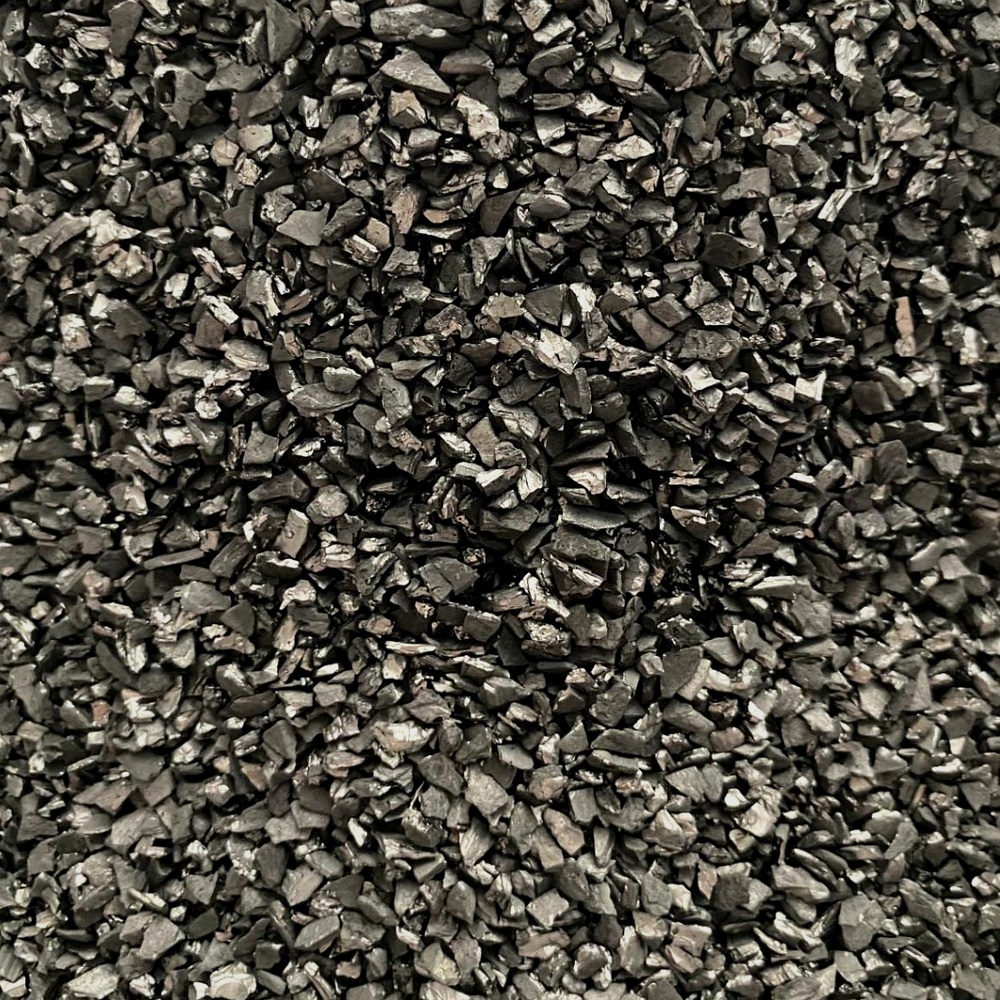
Activated carbon is consumed two ways. It leaves as loaded carbon after elution, and it grinds into fines that report to tailings carrying adsorbed gold. The second loss is rarely budgeted. Ball-pan hardness and AARL attrition predict it; mesh size and platelet count predict how fast it happens in a given circuit. This guide uses AuCarb™ Kub Rov Qab Taub Txiv maj phaub Plhaub Ua Pa roj carbon (≥99% Hardness) as the worked example.
1. Three steps from solution to loaded carbon
Film diffusion — the [Au(CN)₂]⁻ complex crosses the solution boundary layer around each granule. Agitation controls this step.
Pore diffusion — the complex travels into internal pores. Granule size and pore structure control this step.
Surface adsorption — the complex binds to active sites. Surface chemistry and total area control this step.
2. Why hardness is a recovery parameter
A granule that breaks in a stirred tank shortens diffusion paths but creates gold-bearing fines that escape the adsorption circuit. In an abrasive ore, moving from a marginal product to one at ball-pan hardness ≥99% with AARL attrition ≤1.5% cuts fines generation directly. The AC50 verified data set is: 6×12 mesh, ball-pan ≥99%, AARL attrition ≤1.5%, platelet ≤5.0%, K ≥26 kg/t, R ≥50%, CTC ≥50%, butane ≥19.5%, ash ≤3.0%, moisture ≤5.0%, bulk density 0.48–0.55 g/mL. Iodine value is deliberately omitted — published figures conflict, so CTC and butane activity are the auditable measures.
Lub Peb Caug Kub — peb yam khoom, ib tus neeg muag khoom
AuCyan™ Sodium Cyanide NaCN (≥98.3%) · AuCarb™ Kub Rov Qab Tau Cov Roj Carbon Ua Los Ntawm Txiv maj phaub (≥99% Hardness) · AuLeach™ Kub Leaching Agent (GDA) – Tsis Muaj Kev Phom Sij
3. Worked calculation: the cost of fines
A 2,000 t/day CIL plant carries 12 tonnes of carbon with a 30-day cycle. At 1.5% attrition per cycle it loses about 180 kg per cycle, or 2.2 tonnes a year. At 3.0% it loses roughly 4.3 tonnes — a difference of 2.1 tonnes of carbon. If those fines carry even 200 g/t of gold, the annual gold difference is about 420 g. At any reasonable gold price, the hardness premium paid for the better carbon is smaller than the gold saved.
1.5% attrition: ≈ 2.2 t/year make-up carbon
3.0% attrition: ≈ 4.3 t/year make-up carbon
4. K and R are not the same number
K value is the adsorption rate constant — how fast gold loads. R value is equilibrium capacity — how much it holds. A high K with modest R suits short contact time. A high R suits a circuit that runs carbon to heavy loading before elution. Buying on either alone is a common and expensive mistake. Run bottle-roll loading on your own ore, set the K/R target from your contact time, then buy the lowest grade that reaches it.
5. Plaub qib, plaub txoj haujlwm
| qib | Kev Circuit Court | Txhais cov lus qhia tshwj xeeb |
|---|---|---|
| BC1100 | Kev rho tawm ntawm cov khib nyiab / Carbon-hauv-Column | Kev ua haujlwm siab rau cov tshuaj qis dua |
| AC50 | Standard CIP/CIL | 6×12 mesh, K ≥26, R ≥50%, CTC ≥50% |
| AC55 | CIP/CIL uas muaj kev thauj khoom ntau dua | K ≥28 kg/t, R ≥55% |
| AC60 | CIP/CIL zoo tshaj plaws | K ≥30 kg/t, R ≥60%, 8 × 16 lossis 6 × 12 |
6. Kev rov tsim dua tshiab thiab lub neej voj voog
Loaded carbon is eluted and thermally regenerated before returning to the circuit. Every cycle imposes thermal and mechanical stress. Platelets and weak granules are preferentially lost in handling and regeneration. A carbon at ball-pan hardness ≥99% with platelet ≤5.0% typically sustains more cycles before make-up is required. Packing is 25 kg cov hnab PE laminated hnyav, with a batch COA, TDS thiab MSDS. MOQ yog 1 × 20' FCL ≈ 15 MT nyob rau hauv FOB / CIF terms; United Chemical pabcuam ntau dua 77 lub tebchaws.
5b. Screening and fines recovery
Attrition control does not end at the carbon specification. Screen condition determines whether a broken granule is removed cleanly or ground further and carried forward. A worn screen with oversized apertures passes loaded fines into the tailings stream; a blinded screen holds carbon in the tank too long and increases grinding. The practical routine is to log screen aperture, inspect panels on a fixed schedule and sample the carbon size distribution in the circuit monthly. If the proportion of sub-millimetre material is rising while make-up carbon is on budget, the problem is mechanical rather than metallurgical. Equally, gold-bearing fines caught on a screen are not lost; they should be routed to the elution circuit where the recovery economics justify it. This is why hardness and attrition numbers belong in an operating dashboard, not only in the purchase order.
7. Cov FAQ
Q1 — ≥99% qhov nyuaj txhais li cas hauv kev xyaum?
Ball-pan hardness ≥99% means the granule resists mechanical breakdown to a defined standard, reducing fines.
Q2 — Which mesh size?
6×12 for agitated CIP/CIL, 8×16 where finer loading is needed, BC1100 for columns and heap.
Q3 — Koj puas luam tawm tus nqi iodine?
No — CTC and butane activity are the auditable pore measures because published iodine figures conflict.
Q4 — Yuav xa dab tsi nrog txhua pawg?
Cov COA, TDS thiab MSDS ua ke hauv 25 kg hnab PE uas ua los ntawm cov khoom siv hnyav.
Q5 — MOQ yog dab tsi?
1 × 20 'FCL ≈ 15 MT, FOB lossis CIF.
Q6 — Can I test before buying?
Yog — cov qauv kuaj dawb ntawm AuCarb™ thiab AuLeach™ rau kev kuaj hauv chav kuaj ywj pheej.
Measure your attrition loss
Tell us your circuit type, screen aperture and ore abrasiveness. We propose a grade, a K/R target and a test protocol.
Hu Rau Peb · AC50 · AC55 · AC60 · Daim duab qhia txog Golden Triangle
WhatsApp +86 173 9270 5576 · info@unitedchemicalcn.com
- Random Cov ntsiab lus
- Cov ntsiab lus kub
- Kub tshuaj xyuas cov ntsiab lus
- Tuam Tshoj Hoobkas Sulfuric Acid 98%
- Sulfuric Acid 98% Muaj Qib
- Plastic Shock Tube (VOD≧1600m / s)
- Ferrous Sulfate Industrial Qib 90%
- Cov flotation reagents puas muaj kev cuam tshuam ib puag ncig?
- 1Kev txo nqi Sodium Cyanide (CAS: 143-33-9) rau Mining - Siab Zoo & Tus nqi sib tw
- 2Sodium Cyanide 98.3% CAS 143-33-9 NaCN kub hnav khaub ncaws tus neeg sawv cev tseem ceeb rau kev tsuas tshuaj lom neeg kev lag luam
- 3Tuam Tshoj Txoj Cai Tshiab ntawm Sodium Cyanide Exports thiab Kev taw qhia rau cov neeg yuav khoom thoob ntiaj teb
- 4Sodium Cyanide (CAS: 143-33-9) End user certificate (Suav thiab Askiv version)
- 5International Cyanide (Sodium cyanide) Kev Tswj Xyuas Txoj Cai - Kub Mine Txais Cov Qauv
- 6Tuam Tshoj Hoobkas Sulfuric Acid 98%
- 7Anhydrous Oxalic acid 99.6% Muaj Qib
- 1Sodium Cyanide 98.3% CAS 143-33-9 NaCN kub hnav khaub ncaws tus neeg sawv cev tseem ceeb rau kev tsuas tshuaj lom neeg kev lag luam
- 2High Purity · Kev Ua Haujlwm ruaj khov · Kev Txhim Kho Siab dua - sodium cyanide rau niaj hnub kub leaching
- 3United ChemicalPab Pawg Tshawb Fawb Qhia Txog Txoj Cai Los Ntawm Cov Ntaub Ntawv-Driven Insights
- 4AuCyan™ Kev Ua Haujlwm Siab Sodium Cyanide | 98.3% Kev Huv Si rau Kev Khawb Kub Thoob Ntiaj Teb
- 5Digital Electronic Detonator (Lub sijhawm ncua 0 ~ 16000ms)
- 6High-strength, High-precision Shock Tube Detonator
- 7Kev lag luam Electric Detonator










Kev sib tham hauv online
Ntxiv lus: