

UNITED CHEMICAL · TEKNỌLỊKA NGWA AHỊA · 27 NỌVEMBER 2026
The carbon you replace is not the carbon you lose
Fines carry gold out of the circuit, and they rarely appear on the purchase order.
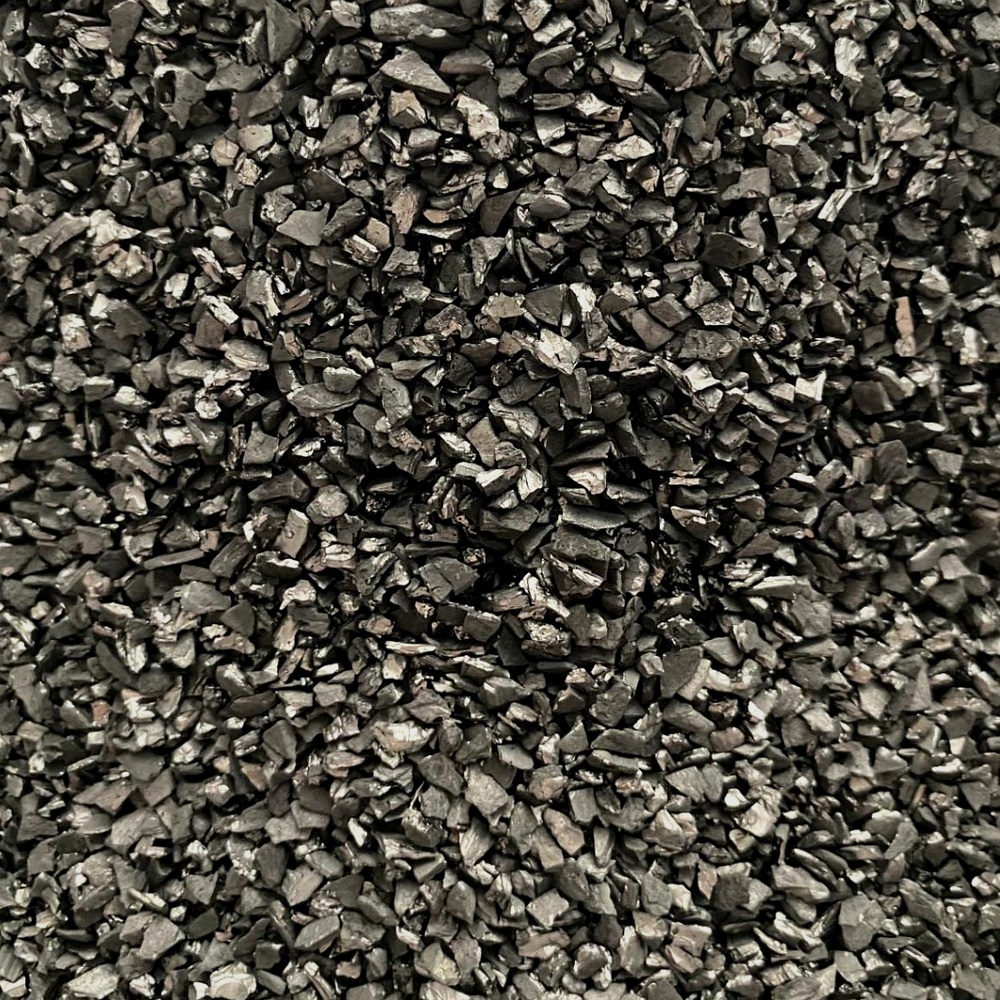
Activated carbon is consumed two ways. It leaves as loaded carbon after elution, and it grinds into fines that report to tailings carrying adsorbed gold. The second loss is rarely budgeted. Ball-pan hardness and AARL attrition predict it; mesh size and platelet count predict how fast it happens in a given circuit. This guide uses AuCarb™ Gold Recovery Shell AuCarb™ Activated Carbon (≥99% Ike) as the worked example.
1. Three steps from solution to loaded carbon
Film diffusion — the [Au(CN)₂]⁻ complex crosses the solution boundary layer around each granule. Agitation controls this step.
Pore diffusion — the complex travels into internal pores. Granule size and pore structure control this step.
Surface adsorption — the complex binds to active sites. Surface chemistry and total area control this step.
2. Why hardness is a recovery parameter
A granule that breaks in a stirred tank shortens diffusion paths but creates gold-bearing fines that escape the adsorption circuit. In an abrasive ore, moving from a marginal product to one at ball-pan hardness ≥99% with AARL attrition ≤1.5% cuts fines generation directly. The AC50 verified data set is: 6×12 mesh, ball-pan ≥99%, AARL attrition ≤1.5%, platelet ≤5.0%, K ≥26 kg/t, R ≥50%, CTC ≥50%, butane ≥19.5%, ash ≤3.0%, moisture ≤5.0%, bulk density 0.48–0.55 g/mL. Iodine value is deliberately omitted — published figures conflict, so CTC and butane activity are the auditable measures.
Triangle Ọlaedo — ngwaahịa atọ, otu onye na-ebubata ya
AuCyan™ Sodium Cyanide NaCN (≥98.3%) · AuCarb™ Gold Recovery Shell AuCarb™ Activated Coconut Shell (≥99% Ike siri ike) · AuLeach™ Gold Leaching AuLeach™ (GDA) – Anaghị akpata ihe egwu
3. Worked calculation: the cost of fines
A 2,000 t/day CIL plant carries 12 tonnes of carbon with a 30-day cycle. At 1.5% attrition per cycle it loses about 180 kg per cycle, or 2.2 tonnes a year. At 3.0% it loses roughly 4.3 tonnes — a difference of 2.1 tonnes of carbon. If those fines carry even 200 g/t of gold, the annual gold difference is about 420 g. At any reasonable gold price, the hardness premium paid for the better carbon is smaller than the gold saved.
1.5% attrition: ≈ 2.2 t/year make-up carbon
3.0% attrition: ≈ 4.3 t/year make-up carbon
4. K and R are not the same number
K value is the adsorption rate constant — how fast gold loads. R value is equilibrium capacity — how much it holds. A high K with modest R suits short contact time. A high R suits a circuit that runs carbon to heavy loading before elution. Buying on either alone is a common and expensive mistake. Run bottle-roll loading on your own ore, set the K/R target from your contact time, then buy the lowest grade that reaches it.
5. Klas anọ, ọrụ anọ
| ọkwa | circuit | Nkọwapụta nkọwapụta |
|---|---|---|
| BC1100 | Ịmịpụta mkpokọ / Carbon-n'ime kọlụm | Ọrụ dị elu maka ngwọta dị ala |
| AC50 | Standard CIP/CIL | 6×12 mesh, K ≥26, R ≥50%, CTC ≥50% |
| AC55 | CIP/CIL dị elu | K ≥28 kg/t, R ≥55% |
| AC60 | CIP/CIL dị elu | K ≥30 kg/t, R ≥60%, 8×16 ma ọ bụ 6×12 |
6. Mmegharị na ndụ okirikiri
Loaded carbon is eluted and thermally regenerated before returning to the circuit. Every cycle imposes thermal and mechanical stress. Platelets and weak granules are preferentially lost in handling and regeneration. A carbon at ball-pan hardness ≥99% with platelet ≤5.0% typically sustains more cycles before make-up is required. Packing is Akpa PE dị arọ nke e ji ihe mkpuchi PE mee nke dị kilogram 25, with a batch COA, TDS na MSDSMOQ bụ 1 × 20' FCL ≈ 15 MT n'okpuru FOB / CIF terms; United Chemical na-eje ozi ihe karịrị mba iri asaa na asaa.
5b. Screening and fines recovery
Attrition control does not end at the carbon specification. Screen condition determines whether a broken granule is removed cleanly or ground further and carried forward. A worn screen with oversized apertures passes loaded fines into the tailings stream; a blinded screen holds carbon in the tank too long and increases grinding. The practical routine is to log screen aperture, inspect panels on a fixed schedule and sample the carbon size distribution in the circuit monthly. If the proportion of sub-millimetre material is rising while make-up carbon is on budget, the problem is mechanical rather than metallurgical. Equally, gold-bearing fines caught on a screen are not lost; they should be routed to the elution circuit where the recovery economics justify it. This is why hardness and attrition numbers belong in an operating dashboard, not only in the purchase order.
7. Ajụjụ
Q1 — Gịnị ka ike ≥99% pụtara n'omume?
Ball-pan hardness ≥99% means the granule resists mechanical breakdown to a defined standard, reducing fines.
Q2 — Which mesh size?
6×12 for agitated CIP/CIL, 8×16 where finer loading is needed, BC1100 for columns and heap.
Q3 — Ị na-ebipụta uru iodine?
No — CTC and butane activity are the auditable pore measures because published iodine figures conflict.
Q4 - Kedu ihe na-ebuga na ogbe ọ bụla?
N'ime akpa COA, TDS na MSDS nke dị kilogram 25 nke e ji akwa PE kpuchie.
Q5 - Gịnị bụ MOQ?
1 × 20' FCL ≈ 15 MT, FOB ma ọ bụ CIF.
Q6 — Can I test before buying?
Ee — ihe nlele efu nke AuCarb™ na AuLeach™ maka nnwale ụlọ nyocha onwe onye.
Measure your attrition loss
Tell us your circuit type, screen aperture and ore abrasiveness. We propose a grade, a K/R target and a test protocol.
Kpọtụrụ Anyị · AC50 · AC55 · AC60 · Nchịkọta nke Golden Triangle
WhatsApp +86 173 9270 5576 · info@unitedchemicalcn.com
- Ọdịnaya enweghị usoro
- Ọdịnaya na-ekpo ọkụ
- Ọdịnaya nyochaa na-ekpo ọkụ
- Ụlọ ọrụ China Sulfuric acid 98%
- Sulfuric acid 98% ụlọ ọrụ mmepụta ihe
- Plastic Shock Tube (VOD≧1600m/s)
- Ọkwa ụlọ ọrụ Ferrous Sulfate 90%
- Ndị na-ese n'elu mmiri nwere mmetụta gburugburu ebe obibi?
- 1Sodium Cyanide akwụghị ụgwọ (CAS: 143-33-9) maka Ngwuputa - Ogo dị elu na ọnụahịa asọmpi.
- 2Sodium Cyanide 98.3% CAS 143-33-9 Ihe eji achọ ọla edo NaCN dị mkpa maka ụlọ ọrụ kemịkalụ nke na-egwupụta ihe
- 3Iwu ọhụrụ nke China gbasara mbupụ sodium Cyanide na ntụzịaka maka ndị na-azụ ahịa mba ụwa
- 4Sodium Cyanide (CAS: 143-33-9) Akwụkwọ njedebe (ụdị Chinese na Bekee)
- 5Cyanide International (Sodium cyanide) Koodu njikwa - ụkpụrụ nnabata nke m ọla edo
- 6Ụlọ ọrụ China Sulfuric acid 98%
- 7Oxalic acid anhydrous 99.6% Ọkwa ụlọ ọrụ
- 1Sodium Cyanide 98.3% CAS 143-33-9 Ihe eji achọ ọla edo NaCN dị mkpa maka ụlọ ọrụ kemịkalụ nke na-egwupụta ihe
- 2Ịdị ọcha dị elu · arụmọrụ kwụsiri ike · mgbake dị elu - cyanide sodium maka ịcha ọla edo nke oge a
- 3United ChemicalNdị otu nyocha na-egosipụta ikike site na nleba anya na-ebute data
- 4AuCyan™ Sodium Cyanide Dị Elu | 98.3% Ịdị ọcha maka Ngwuputa Ọlaedo zuru ụwa ọnụ
- 5Igwe ọkụ eletrik dijitalụ (oge igbu oge 0 ~ 16000ms)
- 6Ike dị elu, nke dị elu nke ọma Shock Tube Detonator
- 7ụlọ ọrụ Electric Detonator










Ndụmọdụ ozi ịntanetị
Tinye okwu: