

UNITED CHEMICAL · TEHNOLOGIE DE PRODUSE · 27 NOIEMBRIE 2026
Carbon you replace is not the carbon you lose
Fines carry gold out of the circuit, and they rarely appear on the purchase order.
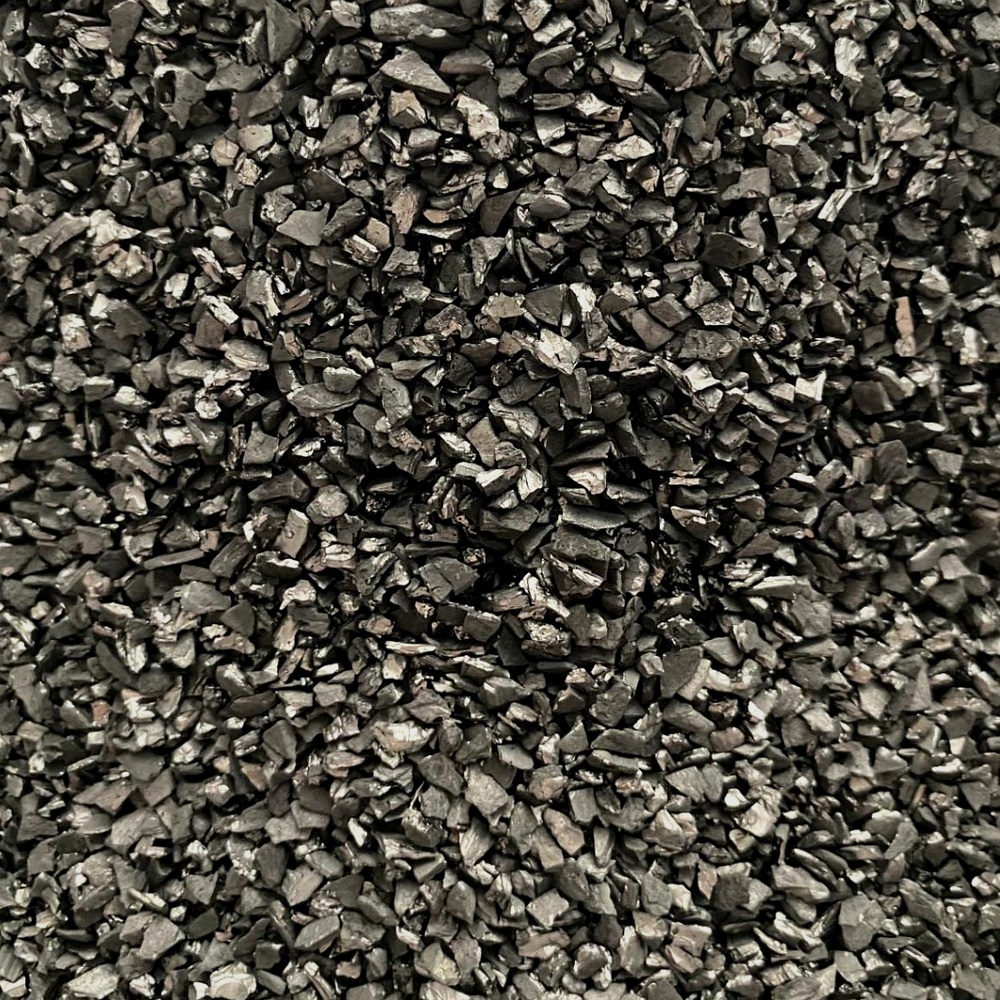
Activated carbon is consumed two ways. It leaves as loaded carbon after elution, and it grinds into fines that report to tailings carrying adsorbed gold. The second loss is rarely budgeted. Ball-pan hardness and AARL attrition predict it; mesh size and platelet count predict how fast it happens in a given circuit. This guide uses Cărbune activ din coajă de cocos AuCarb™ Gold Recovery (duritate ≥99%) as the worked example.
1. Three steps from solution to loaded carbon
Film diffusion — the [Au(CN)₂]⁻ complex crosses the solution boundary layer around each granule. Agitation controls this step.
Pore diffusion — the complex travels into internal pores. Granule size and pore structure control this step.
Surface adsorption — the complex binds to active sites. Surface chemistry and total area control this step.
2. Why hardness is a recovery parameter
A granule that breaks in a stirred tank shortens diffusion paths but creates gold-bearing fines that escape the adsorption circuit. In an abrasive ore, moving from a marginal product to one at ball-pan hardness ≥99% with AARL attrition ≤1.5% cuts fines generation directly. The AC50 verified data set is: 6×12 mesh, ball-pan ≥99%, AARL attrition ≤1.5%, platelet ≤5.0%, K ≥26 kg/t, R ≥50%, CTC ≥50%, butane ≥19.5%, ash ≤3.0%, moisture ≤5.0%, bulk density 0.48–0.55 g/mL. Iodine value is deliberately omitted — published figures conflict, so CTC and butane activity are the auditable measures.
Triunghiul de Aur — trei produse, un furnizor
AuCyan™ Cianură de sodiu NaCN (≥98.3%) · AuCarb™ Cărbune activ din coajă de cocos pentru recuperarea aurului (duritate ≥99%) · AuLeach™ Agent de levigare aur (GDA) – Nepericulos
3. Worked calculation: the cost of fines
A 2,000 t/day CIL plant carries 12 tonnes of carbon with a 30-day cycle. At 1.5% attrition per cycle it loses about 180 kg per cycle, or 2.2 tonnes a year. At 3.0% it loses roughly 4.3 tonnes — a difference of 2.1 tonnes of carbon. If those fines carry even 200 g/t of gold, the annual gold difference is about 420 g. At any reasonable gold price, the hardness premium paid for the better carbon is smaller than the gold saved.
1.5% attrition: ≈ 2.2 t/year make-up carbon
3.0% attrition: ≈ 4.3 t/year make-up carbon
4. K and R are not the same number
K value is the adsorption rate constant — how fast gold loads. R value is equilibrium capacity — how much it holds. A high K with modest R suits short contact time. A high R suits a circuit that runs carbon to heavy loading before elution. Buying on either alone is a common and expensive mistake. Run bottle-roll loading on your own ore, set the K/R target from your contact time, then buy the lowest grade that reaches it.
5. Patru grade, patru locuri de muncă
| Calitate | Circuit | Definirea specificațiilor |
|---|---|---|
| BC1100 | Levigare în grămadă / Carbon în coloană | Activitate ridicată pentru soluții de grad inferior |
| AC50 | Standard CIP/CIL | 6×12 mesh, K ≥26, R ≥50%, CTC ≥50% |
| AC55 | CIP/CIL cu sarcină mai mare | K ≥28 kg/t, R ≥55% |
| AC60 | CIP/CIL premium | K ≥30 kg/t, R ≥60%, 8×16 sau 6×12 |
6. Regenerare și ciclu de viață
Loaded carbon is eluted and thermally regenerated before returning to the circuit. Every cycle imposes thermal and mechanical stress. Platelets and weak granules are preferentially lost in handling and regeneration. A carbon at ball-pan hardness ≥99% with platelet ≤5.0% typically sustains more cycles before make-up is required. Packing is Saci PE laminati rezistenți de 25 kg, with a batch COA, TDS și MSDSMOQ este 1×20' FCL ≈ 15 MT în FOB/CIF terms; United Chemical deservește peste 77 de țări.
5b. Screening and fines recovery
Attrition control does not end at the carbon specification. Screen condition determines whether a broken granule is removed cleanly or ground further and carried forward. A worn screen with oversized apertures passes loaded fines into the tailings stream; a blinded screen holds carbon in the tank too long and increases grinding. The practical routine is to log screen aperture, inspect panels on a fixed schedule and sample the carbon size distribution in the circuit monthly. If the proportion of sub-millimetre material is rising while make-up carbon is on budget, the problem is mechanical rather than metallurgical. Equally, gold-bearing fines caught on a screen are not lost; they should be routed to the elution circuit where the recovery economics justify it. This is why hardness and attrition numbers belong in an operating dashboard, not only in the purchase order.
7. FAQ
Î1 — Ce înseamnă în practică o duritate ≥99%?
Ball-pan hardness ≥99% means the granule resists mechanical breakdown to a defined standard, reducing fines.
Q2 — Which mesh size?
6×12 for agitated CIP/CIL, 8×16 where finer loading is needed, BC1100 for columns and heap.
Î3 — Publicați indicele de iod?
No — CTC and butane activity are the auditable pore measures because published iodine figures conflict.
Î4 — Ce este livrat în fiecare lot?
Certificat de analiză (COA), TDS și MSDS pentru loturi în saci PE laminati rezistenți de 25 kg.
Î5 — Care este cantitatea minimă de bani (MOQ)?
1×20' FCL ≈ 15 MT, FOB sau CIF.
Q6 — Can I test before buying?
Da — mostre gratuite de AuCarb™ și AuLeach™ pentru teste de laborator independente.
Measure your attrition loss
Tell us your circuit type, screen aperture and ore abrasiveness. We propose a grade, a K/R target and a test protocol.
Contactează-ne · AC50 · AC55 · AC60 · Prezentare generală a Triunghiului de Aur
WhatsApp +86 173 9270 5576 · info@unitedchemicalcn.com
- Conținut aleatoriu
- Conținut fierbinte
- Conținut fierbinte de recenzii
- Fabrica din China Acid sulfuric 98%
- Acid sulfuric 98% grad industrial
- Tub de șoc din plastic(VOD≧1600m/s)
- Sulfat feros de calitate industrială 90%
- Reactivii de flotație au impact asupra mediului?
- 1Cianură de sodiu cu reducere (CAS: 143-33-9) pentru minerit - Calitate înaltă și prețuri competitive
- 2Cianură de sodiu 98.3% CAS 143-33-9 NaCN agent de finisare a aurului esențial pentru industria chimică minieră
- 3Noile reglementări ale Chinei privind exporturile de cianură de sodiu și îndrumări pentru cumpărătorii internaționali
- 4Cianură de sodiu (CAS: 143-33-9) Certificat de utilizator final (versiunea chineză și engleză)
- 5Cianură internațională (cianura de sodiu) Cod de management - Standarde de acceptare pentru mine de aur
- 6Fabrica din China Acid sulfuric 98%
- 7Acid oxalic anhidru 99.6% grad industrial
- 1Cianură de sodiu 98.3% CAS 143-33-9 NaCN agent de finisare a aurului esențial pentru industria chimică minieră
- 2Puritate ridicată · Performanță stabilă · Recuperare mai mare — cianură de sodiu pentru levigarea modernă a aurului
- 3United ChemicalEchipa de cercetare demonstrează autoritate prin intermediul informațiilor bazate pe date
- 4Cianură de sodiu de înaltă performanță AuCyan™ | Puritate 98.3% pentru mineritul aurului la nivel global
- 5Detonator electronic digital (Timp de întârziere 0 ~ 16000 ms)
- 6Detonator cu tub de șoc de înaltă rezistență, de înaltă precizie
- 7industrie Detonator electric










Consultare mesaj online
Adauga comentariu: