

UNITED CHEMICAL · 产品技术 · 2026年11月27日
此 碳 you replace is not the carbon you lose
Fines carry gold out of the circuit, and they rarely appear on the purchase order.
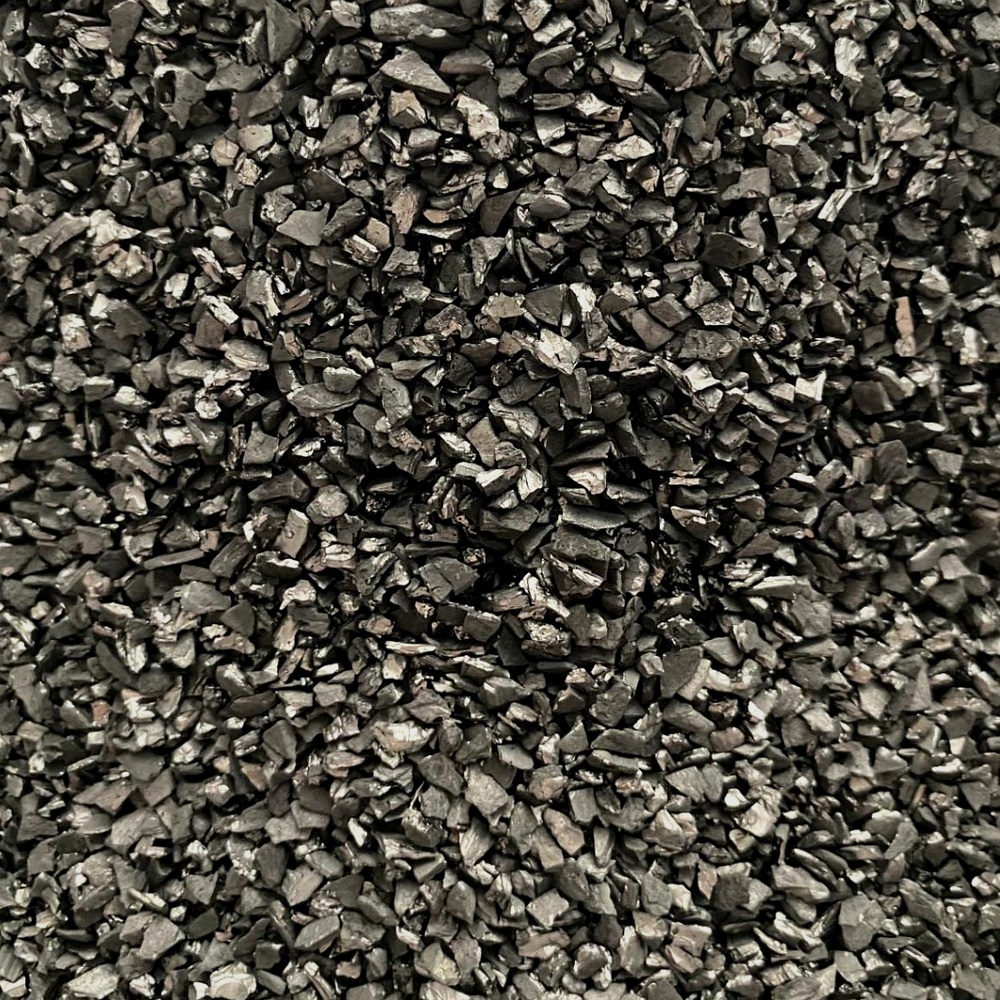
Activated carbon is consumed two ways. It leaves as loaded carbon after elution, and it grinds into fines that report to tailings carrying adsorbed gold. The second loss is rarely budgeted. Ball-pan hardness and AARL attrition predict it; mesh size and platelet count predict how fast it happens in a given circuit. This guide uses AuCarb™ 黄金回收椰壳活性炭(硬度≥99%) as the worked example.
1. Three steps from solution to loaded carbon
Film diffusion — the [Au(CN)₂]⁻ complex crosses the solution boundary layer around each granule. Agitation controls this step.
Pore diffusion — the complex travels into internal pores. Granule size and pore structure control this step.
表面吸附 — the complex binds to active sites. Surface chemistry and total area control this step.
2. Why hardness is a recovery parameter
A granule that breaks in a stirred tank shortens diffusion paths but creates gold-bearing fines that escape the adsorption circuit. In an abrasive ore, moving from a marginal product to one at ball-pan hardness ≥99% with AARL attrition ≤1.5% cuts fines generation directly. The AC50 verified data set is: 6×12 mesh, ball-pan ≥99%, AARL attrition ≤1.5%, platelet ≤5.0%, K ≥26 kg/t, R ≥50%, CTC ≥50%, butane ≥19.5%, ash ≤3.0%, moisture ≤5.0%, bulk density 0.48–0.55 g/mL. Iodine value is deliberately omitted — published figures conflict, so CTC and butane activity are the auditable measures.
金三角——三种产品,一家供应商
AuCyan™ 氰化钠 (NaCN) (≥98.3%) · AuCarb™ 黄金回收椰壳活性炭 (≥99% 硬度) · AuLeach™ 黄金浸出剂 (GDA) – 无害
3. Worked calculation: the cost of fines
A 2,000 t/day CIL plant carries 12 tonnes of carbon with a 30-day cycle. At 1.5% attrition per cycle it loses about 180 kg per cycle, or 2.2 tonnes a year. At 3.0% it loses roughly 4.3 tonnes — a difference of 2.1 tonnes of carbon. If those fines carry even 200 g/t of gold, the annual gold difference is about 420 g. At any reasonable gold price, the hardness premium paid for the better carbon is smaller than the gold saved.
1.5% attrition: ≈ 2.2 t/year make-up carbon
3.0% attrition: ≈ 4.3 t/year make-up carbon
4. K and R are not the same number
K value is the adsorption rate constant — how fast gold loads. R value is equilibrium capacity — how much it holds. A high K with modest R suits short contact time. A high R suits a circuit that runs carbon to heavy loading before elution. Buying on either alone is a common and expensive mistake. Run bottle-roll loading on your own ore, set the K/R target from your contact time, then buy the lowest grade that reaches it.
5. 四个等级,四种职业
| 年级 | 跑道 | 定义规范 |
|---|---|---|
| BC1100 | 堆浸/柱层析 | 对低品位溶液具有高活性 |
| AC50 | Standard CIP/CIL | 6×12 mesh, K ≥26, R ≥50%, CTC ≥50% |
| AC55 | 高负荷CIP/CIL | K ≥28 kg/t,R ≥55% |
| AC60 | 高级CIP/CIL | K ≥30 kg/t,R ≥60%,8×16 或 6×12 |
6. 再生和循环寿命
Loaded carbon is eluted and thermally regenerated before returning to the circuit. Every cycle imposes thermal and mechanical stress. Platelets and weak granules are preferentially lost in handling and regeneration. A carbon at ball-pan hardness ≥99% with platelet ≤5.0% typically sustains more cycles before make-up is required. Packing is 25公斤重型复合聚乙烯袋, with a batch COA, TDS 和 MSDS认证最小起订量是 1×20英尺集装箱 ≈ 15吨 下 离岸价/到岸价 条款; United Chemical 服务覆盖超过77个国家。
5b. Screening and fines recovery
Attrition control does not end at the carbon specification. Screen condition determines whether a broken granule is removed cleanly or ground further and carried forward. A worn screen with oversized apertures passes loaded fines into the tailings stream; a blinded screen holds carbon in the tank too long and increases grinding. The practical routine is to log screen aperture, inspect panels on a fixed schedule and sample the carbon size distribution in the circuit monthly. If the proportion of sub-millimetre material is rising while make-up carbon is on budget, the problem is mechanical rather than metallurgical. Equally, gold-bearing fines caught on a screen are not lost; they should be routed to the elution circuit where the recovery economics justify it. This is why hardness and attrition numbers belong in an operating dashboard, not only in the purchase order.
7。 常问问题
Q1 — ≥99% 硬度在实际应用中意味着什么?
Ball-pan hardness ≥99% means the granule resists mechanical breakdown to a defined standard, reducing fines.
Q2 — Which mesh size?
6×12 for agitated CIP/CIL, 8×16 where finer loading is needed, BC1100 for columns and heap.
Q3 — 你们公布碘值吗?
No — CTC and butane activity are the auditable pore measures because published iodine figures conflict.
第四季度——每批货物都包含哪些东西?
批次 COA、TDS 和 MSDS 装在 25 公斤重型复合 PE 袋中。
Q5 — 最低起订量是多少?
1×20' FCL ≈ 15 公吨,FOB 或 CIF。
Q6 — Can I test before buying?
是的——我们提供 AuCarb™ 和 AuLeach™ 的免费样品,供独立实验室进行测试。










在线留言咨询
添加评论: