
To improve the economical use of activated Carbon in gold recovery processes, attention should be drawn on proper acid washing and efficient regeneration.
Thermal regenerations' only objective is to remove the organics loaded on carbon and it has thus to be temperature controlled to avoid overburning.
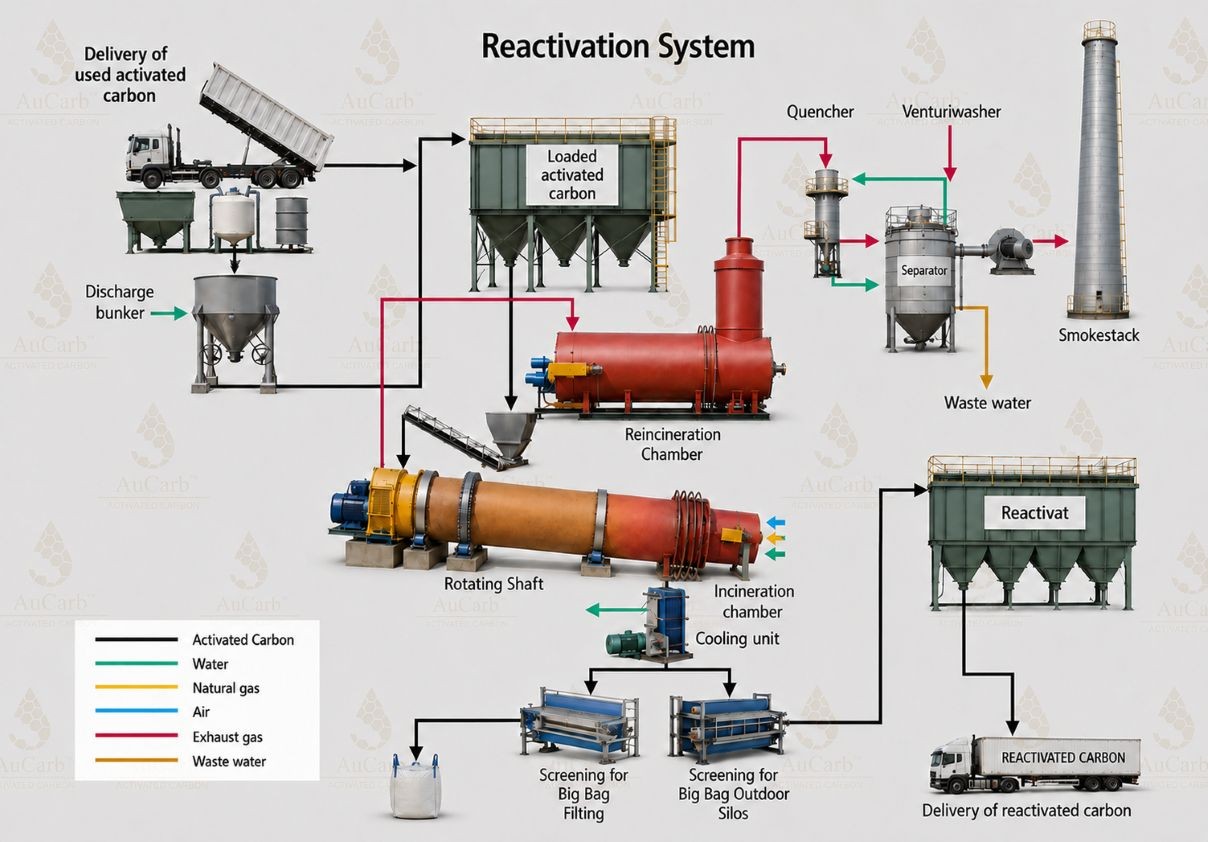
In the thermal reactivation process, the loaded Activated Carbon passes through several temperature zones within the reactivation furnace, where it is continuously heated to increasingly higher temperatures of up to 1,000 ℃.
During this controlled temperature increase, the substances adsorbed by the activated carbon begin to detach from its internal surface (desorption). The now unloaded activated carbon is then reactivated by steam. This restores and, if necessary, expands the internal pore structure, and the resulting reactivated material can be reused.
The substances that pass into the gas phase during this reactivation process are eliminated in an afterburner at temperatures of up to 1,200 ℃. The resulting flue gas undergoes careful post-treatment to ensure that the entire reactivation process complies with current environmental regulations.
In many cases, loaded or exhausted granular activated carbons can be reactivated by a thermal process similar to the original activation process. The activated carbon can then be reused. Reactivation is therefore an environmentally friendly and cost-effective alternative to disposal.
Various types of equipment are used for the reactivation of activated carbons, such as:
rotary kilns、multi-stage kilns、fluidized bed kilns
During reactivation, the activated carbon undergoes the following process steps:
1.drying up to 100℃
2.desorption and pyrolysis of pollutants from 100 to 700℃
3.reactivation of the activated carbon above 700℃ (water-gas reaction)
C + H2O → CO + H₂
The process control, which is adapted to the respective requirements and the different types of activated carbon, ensures a high quality of the reactivated material. As a rule, the original adsorption capacity of the activated carbon can be restored.
- Random Content
- Hot content
- Hot review content
- Flexible Customer and Supplier Relations Specialist (Location: India)
- Magneto Electric Detonator(Anti stray current)
- Sodiumsulfite Technical Grade 96%-98%
- What role do mining chemicals play in the mining industry?
- What are the storage and handling precautions for mining chemicals?
- sodium O,O-diethyl dithiophosphate
- Sodium Diisobutyl Dithiophosphate/Dithiophosphate 49% - 53%
- 1Discounted Sodium Cyanide (CAS: 143-33-9) for Mining - High Quality & Competitive Pricing
- 2Sodium Cyanide 98.3% CAS 143-33-9 NaCN gold dressing agent Essential for Mining Chemical Industries
- 3China's New Regulations on Sodium Cyanide Exports and Guidance for International Buyers
- 4Sodium Cyanide (CAS: 143-33-9) End user certificate (Chinese and English version)
- 5International Cyanide(Sodium cyanide) Management Code - Gold Mine Acceptance Standards
- 6China factory Sulfuric Acid 98%
- 7Anhydrous Oxalic acid 99.6% Industrial Grade
- 1Sodium Cyanide 98.3% CAS 143-33-9 NaCN gold dressing agent Essential for Mining Chemical Industries
- 2High Purity · Stable Performance · Higher Recovery — sodium cyanide for modern gold leaching
- 3United Chemical's Research Team Demonstrates Authority Through Data-Driven Insights
- 4AuCyan™ High-Performance Sodium Cyanide | 98.3% Purity for Global Gold Mining
- 5Digital Electronic Detonator(Delay time 0~ 16000ms)
- 6High-strength, High-precision Shock Tube Detonator
- 7industry Electric Detonator


Online message consultation
Add comment: