
UNITED CHEMICAL · PRODUCT TECHNOLOGY · 20 NOVEMBER 2026
Dissolution rate is the variable most plants forget to specify
A buyer specifies assay. A metallurgist must specify dissolution. The gap between the two is where cyanide budget goes to die.
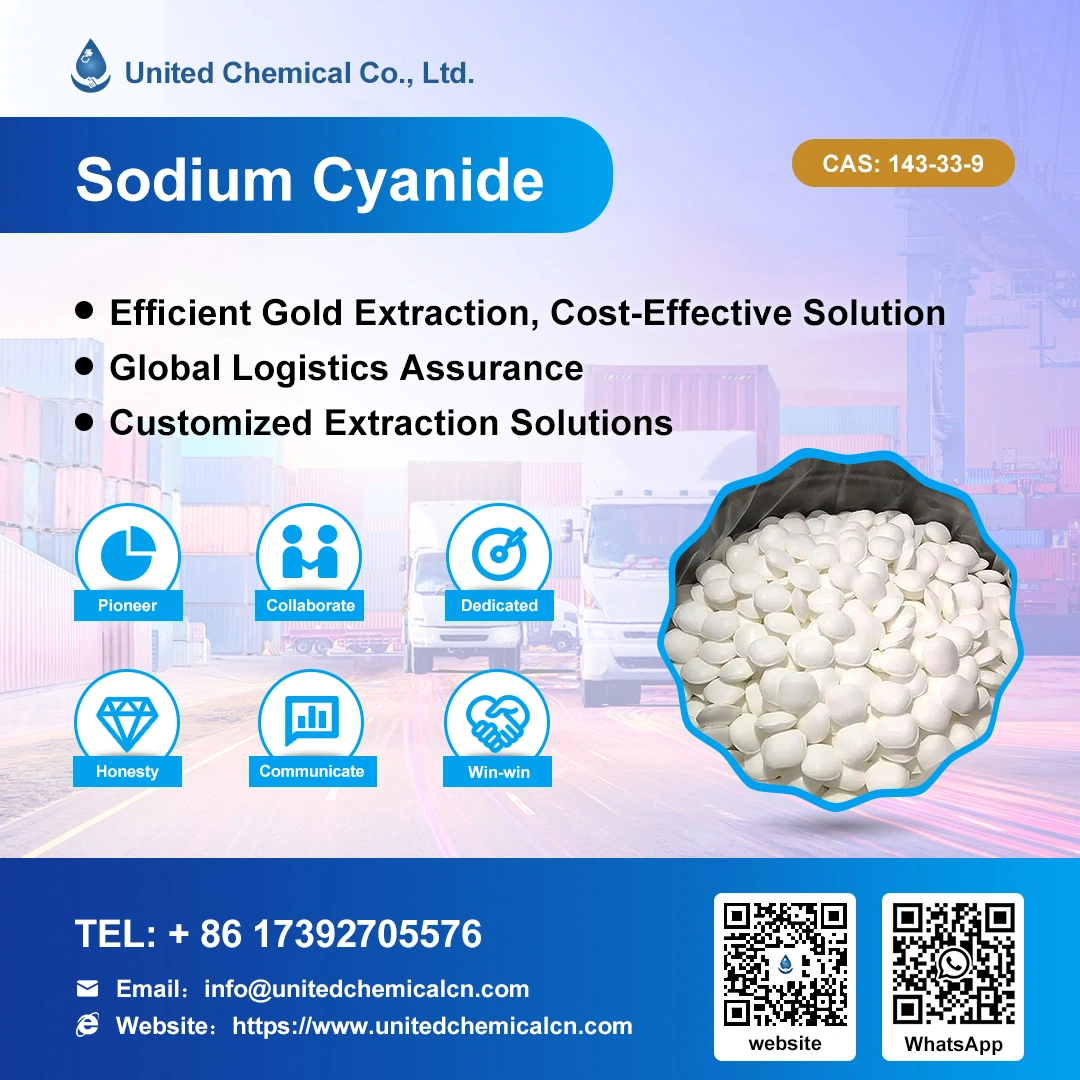
When a gold plant purchases Sodium Cyanide, the purchase order usually carries a single number: purity. Yet the number that decides how many kilograms disappear per tonne of ore is how fast the briquette releases cyanide into solution, and how consistently the circuit holds a free-cyanide setpoint. A high-purity product that dissolves unevenly creates dosing lag, over-addition and WAD-cyanide excursions. A product that dissolves predictably lets the operator run closer to the theoretical minimum. This manual sets out the working parameters for specifying AuCyan™ Sodium Cyanide NaCN (≥98.3%) on dissolution performance rather than on paper purity alone, and gives a plant-ready method for controlling it.
1. The chemistry you are actually paying for
Gold dissolution in cyanide solution follows the Elsner equation. Four atoms of gold react with eight atoms of cyanide, one molecule of oxygen and two molecules of water to form four units of the gold-cyanide complex and four hydroxide ions:
4 Au + 8 CN⁻ + O₂ + 2 H₂O → 4 [Au(CN)₂]⁻ + 4 OH⁻
The stoichiometry is unambiguous: eight moles of cyanide per four moles of gold, or two moles of cyanide per mole of gold dissolved. In mass terms that is roughly 0.5 g of NaCN per gram of gold. A one-tonne ore stream grading 2 g/t and recovering 95% of its gold consumes only about 0.95 g of cyanide per tonne in the ideal reaction. Real plants consume hundreds of grams per tonne. The difference is not chemistry — it is everything else in the ore and the circuit.
2. Where the other 99% of cyanide goes
Understanding the consumption ledger is the single highest-value exercise in a cyanidation circuit. The theoretical gold reaction is small; the practical losses are large and divisible into five buckets.
| Loss bucket | Mechanism | Control lever |
|---|---|---|
| Gold dissolution | Stoichiometric, ~0.5 g NaCN per g Au | Not controllable; the useful consumption |
| Base-metal demand | Copper, zinc, iron form stable cyano-complexes | Ore blending, pre-treatment, higher setpoint |
| Hydrolysis | CN⁻ + H₂O ↔ HCN + OH⁻ below pH 10.5 | Lime addition, pH interlock |
| Degradation | Oxidation to cyanate, thiocyanate formation | Avoid oxidants, control residence time |
| Physical losses | Incomplete dissolution, entrainment in tails | Briquette dissolution profile, mixing |
The Golden Triangle — three products, one supplier
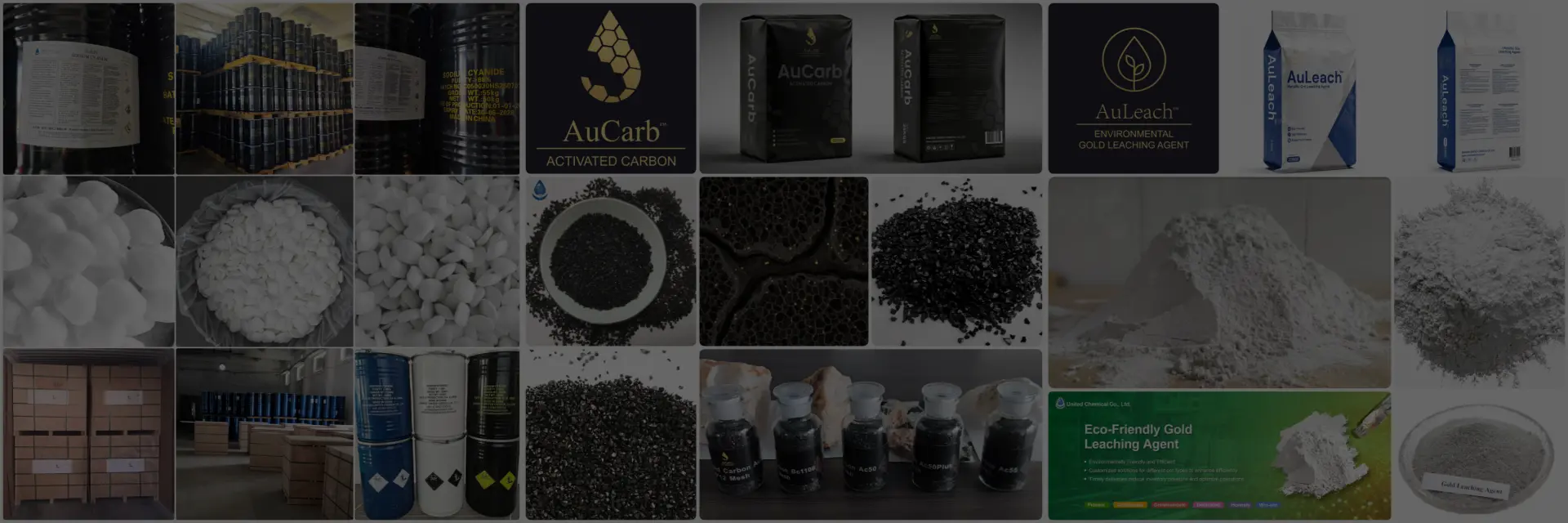
AuCyan™ Sodium Cyanide NaCN (≥98.3%) · AuCarb™ Gold Recovery Coconut Shell Activated Carbon (≥99% Hardness) · AuLeach™ Gold Leaching Agent (GDA) – Non-Hazardous
3. Why ≥98.3% is a floor, not a target
Purity sets the ceiling on available cyanide per kilogram, but insoluble matter and slower briquette breakdown set the realised value. Unextracted cyanide leaves the circuit in the tailings or as an unreacted core, where it is paid for but never dissolves gold. A sodium cyanide product at ≥98.3% with a defined dissolution profile closes that gap. Specification should therefore carry four clauses, not one: minimum assay, dissolution time at circuit pH, maximum insoluble content and batch-to-batch variance.
4. Briquette versus flakes versus powder
| Form | Dissolution behaviour | Plant fit |
|---|---|---|
| High-purity briquette | Controlled, predictable surface-area release | Preferred for metered CIP/CIL dosing |
| Flakes | Fast initial release, variable sizing | Batch make-up where speed dominates |
| Powder | Very fast, dust and handling concerns | Restricted, enclosed dosing only |
5. Worked mass balance — a 3,000 t/day CIL circuit
Take a circuit treating 3,000 tonnes of ore per day at a target free cyanide of 0.25 g/L, a solution-to-solids ratio of 1.2:1 and a measured ore demand of 0.30 kg NaCN per tonne. Theoretical in-circuit inventory is 3,000 × 1.2 m³ × 0.25 kg/m³ = 900 kg. Daily ore demand is 3,000 × 0.30 = 900 kg/day. If briquette dissolution lags by one tank residence time, operators commonly add 8–12% extra to protect the setpoint. That is 72–108 kg/day of avoidable consumption, or roughly 26–39 tonnes per year. At a typical delivered price, a single percentage point of dissolution-driven over-dosing is a five-figure annual line item.
Circuit inventory: 3,000 t × 1.2 × 0.25 kg/m³ = 900 kg
Ore demand: 3,000 t × 0.30 kg/t = 900 kg/day
Lag penalty at 10%: 90 kg/day ≈ 33 t/year
6. Impurity-driven scaling and the cyanide ledger
Scaling is often treated as a mechanical problem, but in cyanidation it is a chemistry problem with a mechanical symptom. Copper, zinc and iron accumulate as cyano-complexes and can precipitate as insoluble salts on pipework, screen surfaces and Carbon. The practical response is threefold: characterise the ore's cyanide demand before the campaign, hold protective alkalinity so that cyanide stays as CN⁻ rather than volatile HCN, and keep a consistent product with low insoluble content so that what is dosed actually dissolves.
7. Documented, not assumed
Every shipment is supplied with a batch COA, TDS and MSDS. Briquettes are packed in 25 kg heavy-duty laminated PE bags. Commercial supply starts at a factory MOQ of 1×20' FCL ≈ 18 MT, under FOB/CIF terms only. Sodium cyanide is a controlled dangerous good (UN1689, DG Class 6.1): import licence and End-Use Certificate are arranged before shipment. United Chemical is a manufacturer and global supplier of gold extraction chemicals, delivering to mining operations in more than 77 countries.
8. Troubleshooting table
| Symptom | Likely cause | Corrective action |
|---|---|---|
| Free CN drifting low | Dissolution lag or ore-demand spike | Verify briquette dissolution, re-run bottle roll |
| High WAD cyanide in tails | Over-dosing to protect setpoint | Tighten dosing curve, check pH |
| White precipitate on screens | Base-metal cyano-complexes | Ore blend, alkaline wash, scale review |
| Slow gold dissolution | Low oxygen or low free CN | Check aeration, restore setpoint |
| Dosing pump cavitation | Undissolved briquette fragments | Extend make-up time, verify mixing |
9. Frequently asked questions
Q1 — Why specify ≥98.3% rather than a higher number?
Because dissolution behaviour and insoluble content matter more to consumed kilograms than the last fraction of a percent of assay. ≥98.3% is a guaranteed floor with a documented dissolution profile.
Q2 — How fast should a briquette dissolve?
The right answer is site-specific. What matters is a consistent, reproducible dissolution curve at your circuit pH and temperature, so dosing can be calibrated once and held.
Q3 — What documentation ships with each lot?
A batch COA, TDS and MSDS covering assay, dissolution behaviour and handling. No other inspection arrangement is offered or implied.
Q4 — Which commercial terms are available?
FOB and CIF only, from a factory MOQ of 1×20' FCL ≈ 18 MT.
Q5 — Is the product a controlled good?
Yes. Sodium cyanide is UN1689, DG Class 6.1. Import licence and End-Use Certificate are arranged before shipment.
Q6 — Can the same supplier provide adsorption carbon?
Yes. AuCarb™ Gold Recovery Coconut Shell Activated Carbon (≥99% Hardness) is supplied from the same technical team, with batch COA, TDS and MSDS.
Q7 — What if the ore is cyanide-constrained?
AuLeach™ Gold Leaching Agent (GDA) – Non-Hazardous is the alternative route for projects where permissible cyanide use is constrained. Bottle-roll comparison is recommended before selection.
Q8 — How many countries do you supply?
More than 77 countries, under FOB/CIF terms with consistent batch documentation.
Request a technical quotation
Send your ore grade, target free-cyanide setpoint and throughput. Our team returns a dissolution-matched dosage proposal with COA, TDS and MSDS.
Contact Us · Golden Triangle overview · Sodium cyanide reference · Chemical FAQs · Industry News
WhatsApp +86 173 9270 5576 · info@unitedchemicalcn.com
- Random Content
- Hot content
- Hot review content
- Plastic Shock Tube(VOD≧1600m/s)
- Ferrous Sulfate Industrial Grade 90%
- Industrial Acetic Acid 99.5% Colorless Liquid Glacial acetic acid
- Industrial Sodium Nitrite 98.5%
- What are the storage and handling precautions for mining chemicals?
- 1Discounted Sodium Cyanide (CAS: 143-33-9) for Mining - High Quality & Competitive Pricing
- 2Sodium Cyanide 98.3% CAS 143-33-9 NaCN gold dressing agent Essential for Mining Chemical Industries
- 3China's New Regulations on Sodium Cyanide Exports and Guidance for International Buyers
- 4Sodium Cyanide (CAS: 143-33-9) End user certificate (Chinese and English version)
- 5International Cyanide(Sodium cyanide) Management Code - Gold Mine Acceptance Standards
- 6China factory Sulfuric Acid 98%
- 7Anhydrous Oxalic acid 99.6% Industrial Grade
- 1Sodium Cyanide 98.3% CAS 143-33-9 NaCN gold dressing agent Essential for Mining Chemical Industries
- 2High Purity · Stable Performance · Higher Recovery — sodium cyanide for modern gold leaching
- 3United Chemical's Research Team Demonstrates Authority Through Data-Driven Insights
- 4AuCyan™ High-Performance Sodium Cyanide | 98.3% Purity for Global Gold Mining
- 5Digital Electronic Detonator(Delay time 0~ 16000ms)
- 6High-strength, High-precision Shock Tube Detonator
- 7industry Electric Detonator


Online message consultation
Add comment: